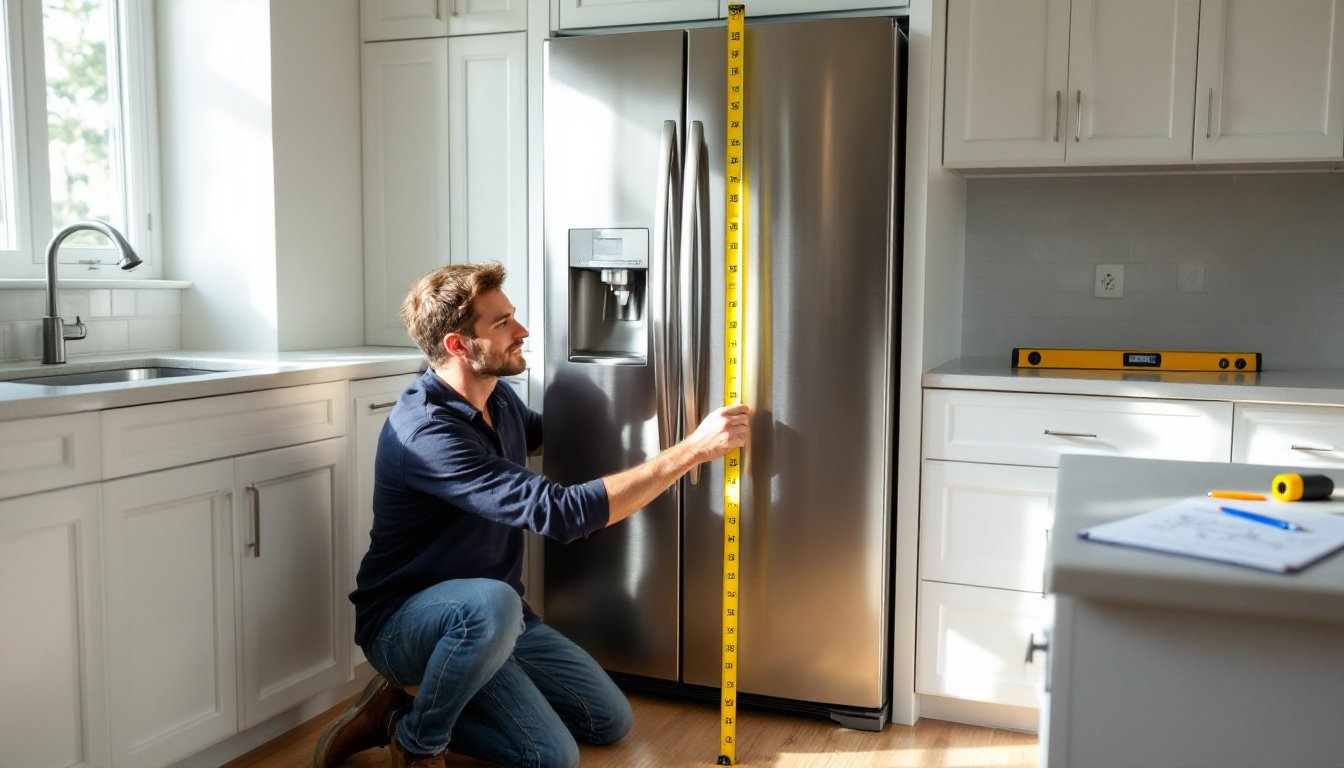
Nothing derails a kitchen remodel faster than a brand-new refrigerator that doesn’t fit. A quarter-inch miscalculation can mean hours of cabinet modification, returned appliances, or worse, a fridge jutting awkwardly into your kitchen’s traffic pattern. Whether replacing an old unit or planning a new kitchen layout, measuring correctly the first time saves money, time, and frustration. This guide walks through the exact steps to measure both your refrigerator and the space it’ll occupy, accounting for the clearances and quirks that most homeowners overlook until delivery day.
Table of Contents
ToggleKey Takeaways
- Measure your refrigerator precisely before purchase to avoid costly returns, cabinet modifications, or poor kitchen fit—accounting for door swing, ventilation, and delivery clearances that most homeowners overlook.
- A 25-foot tape measure, level, notepad, and flashlight are essential tools for accurately measuring both the appliance and the space, as manufacturer spec sheets may not reflect real-world dimensions with handles and hinges.
- Measure three depths separately: cabinet depth for counter-depth alignment, total depth with handles closed for wall clearance, and door-open depth to ensure doors won’t hit adjacent walls, islands, or cabinets.
- Always measure the installation space at multiple points (top, middle, bottom for width; check for slopes with a level) and verify the delivery path through doorways, hallways, and tight turns with accurate diagonal clearance calculations.
- Most units require 1 inch above for ventilation, 1/2 to 1 inch on each side, and 2–4 inches behind for water lines and connections—requirements that vary by model and must be confirmed in the manufacturer’s installation manual.
- Perform a final four-point check: refrigerator width + 1 inch, height + 1 inch, depth + 2 inches, and door swing depth all must fit the space without blocking functionality or obstructing traffic flow.
Why Accurate Refrigerator Measurements Matter
Most refrigerators need more room than their exterior dimensions suggest. Clearance space is essential for three reasons: door swing, ventilation, and installation logistics.
Door swing clearance determines whether you can actually open the fridge fully to remove drawers, shelves, or large items like a turkey. A door that opens only 90 degrees instead of the full 110–120 degrees becomes a daily annoyance. Counter-depth models typically need 2–3 inches on the hinge side, while full-depth units may require 4–6 inches depending on handle style.
Ventilation clearance keeps the compressor from overheating and voiding your warranty. Most manufacturers specify 1 inch on each side and 1–2 inches above the unit. Built-in and panel-ready models have different requirements, some vent through the toe kick, others need top clearance. Check the installation manual before assuming standard spacing works.
Delivery and installation clearances matter if you’re dealing with tight doorways, narrow hallways, or staircases. A refrigerator that technically fits the kitchen space but can’t navigate the route from your front door is an expensive problem. Delivery crews can remove doors and hinges, but there are physical limits. Measure doorways, hallway widths, and any 90-degree turns along the delivery path.
Skipping these measurements is the number-one reason homeowners end up with appliances they can’t use or have to return. The appliance installation guides tested by major consumer publications consistently emphasize clearance as the most overlooked factor in refrigerator fit.
Essential Tools You’ll Need
You don’t need a full toolbox to measure a refrigerator, but the right tools ensure accuracy.
Required tools:
- 25-foot tape measure – A 12-footer won’t reach for measuring delivery paths or ceiling height in open-concept spaces. Look for a tape with a 1-inch-wide blade: it stays rigid when extended horizontally and won’t sag mid-measurement.
- Notepad and pencil – Your phone works, but paper doesn’t autocorrect your numbers or lose them when the screen times out.
- Level (4-foot recommended) – If your floor isn’t level, you’ll need to account for it. A fridge that’s shimmed up in the back adds to the overall height.
- Flashlight or headlamp – Cabinet interiors and behind existing appliances are dark. You’ll need light to check for obstructions like water lines, electrical outlets, or ductwork.
Optional but helpful:
- Stud finder – If you’re measuring for a built-in or need to confirm wall thickness for a flush installation.
- Laser distance measurer – Faster and more accurate than a tape for large spaces, especially if working alone.
- Painter’s tape – Use it to mark measurements on the floor or wall temporarily. Helps visualize door swing and clearances.
Don’t rely on old measurements from a previous appliance. Floors settle, cabinets sag, and manufacturers change product dimensions across model years. Measure fresh every time.
How to Measure Your Refrigerator Dimensions
Start with the actual appliance if you’re measuring an existing fridge for replacement or verifying a new unit’s specs. Manufacturer spec sheets are helpful but not always 100% accurate, tolerances exist, and handles or hinges sometimes add bulk not reflected in the listed dimensions.
Measuring Height
Measure from the floor to the highest point of the refrigerator. This is usually the top of the cabinet, not the hinge or any decorative trim.
- Place the tape measure on the floor directly in front of the fridge, not on a rug or mat.
- Extend it vertically to the tallest point. If the fridge has adjustable legs (most do), note whether they’re fully extended or retracted. Adjustable legs typically offer 1–2 inches of height range.
- Add clearance. Most units need 1 inch minimum above for ventilation, but check the manual. Some compressor designs require more.
Common mistake: Measuring to the top of the door instead of the cabinet body. On French-door models especially, the hinge assembly can add another inch.
If replacing an existing fridge, also measure the ceiling height in the space where it sits. Soffits, crown molding, and recessed lighting can reduce usable height. Subtract trim and障碍物 from your ceiling measurement to find the maximum appliance height that’ll fit.
Measuring Width
Width is measured at the widest point, which is usually the door handles or, on handleless models, the cabinet body.
- Measure straight across from the furthest left point to the furthest right point. On models with asymmetric handles (common on side-by-side units), make sure you’re capturing the full width.
- If the refrigerator is still in its space, pull it forward a few inches to ensure you’re not measuring at an angle due to uneven floors.
- Note the width at both the top and bottom. If your floor isn’t level or the fridge is shimmed, these numbers may differ by 1/4 to 1/2 inch. Use the larger measurement.
Side clearance depends on kitchen layout. If the fridge sits between two cabinets or walls, you’ll need 1/2 inch to 1 inch on each side for installation wiggle room and ventilation. For kitchen organization tips that factor in appliance clearances, many designers recommend the full inch to allow easier removal during future remodels.
Measuring Depth
Depth is the trickiest measurement because it involves three different numbers: cabinet depth, door depth, and total depth with doors open.
Cabinet depth (also called case depth):
- Measure from the back of the refrigerator cabinet, not including handles, hinges, or water line connections, to the front edge of the cabinet body.
- This number matters for counter-depth installations, where you want the fridge front to align with your countertops (typically 24–25 inches deep).
Total depth (with doors closed and handles):
- Measure from the very back of the unit, including any protruding coils, water connections, or compressor housing, to the furthest forward point (usually the handle).
- Standard-depth refrigerators are typically 30–36 inches total depth. Counter-depth models are 24–30 inches.
- Check what’s behind the fridge space. If there’s a water line, electrical outlet, or baseboard, you may not be able to push the unit flush to the wall. Add 2–4 inches for connection clearance in most cases.
Depth with doors open:
- Open each door to its full range (typically 90–120 degrees depending on hinge design).
- Measure from the back wall (or the back of the appliance if already installed) to the furthest point of the open door.
- This tells you whether the door will hit an adjacent wall, island, or cabinet when opened. Many home maintenance checklists include verifying appliance door swing as part of kitchen safety and functionality.
If you’re working from a spec sheet instead of a physical unit, note that manufacturers sometimes list “depth without handles” and “depth with handles” separately. Always use the larger total-depth figure for space planning.
Measuring the Space Where Your Refrigerator Will Go
Measuring the cutout or alcove is just as critical as measuring the appliance itself. A fridge that fits on paper can still fail in practice if you don’t account for obstructions, uneven surfaces, or installation access.
Step-by-step space measurement:
- Measure height from the floor to the underside of any cabinet, soffit, or ceiling. Use the lowest point if there’s any sag or unevenness. Subtract 1–2 inches for clearance.
- Measure width between the inside faces of cabinets or walls on either side. Measure at the top, middle, and bottom, walls aren’t always plumb. Use the narrowest measurement. Subtract 1/2 to 1 inch total (1/4 to 1/2 inch per side) for installation clearance.
- Measure depth from the back wall to the front edge of your countertops (if you want a flush look) or to where you’d like the fridge front to sit. Check for obstructions:
- Electrical outlets – These often sit 4–6 inches from the floor and protrude 1–1.5 inches from the wall. You may need a wall plate spacer or recessed outlet box.
- Water supply lines – Typically protrude 1–2 inches. Some installers use recessed boxes: others just leave slack.
- Baseboards and trim – These can add 1/2 to 3/4 inch. You may need to trim or remove them for a tight fit.
- Check the floor with a level. If it slopes more than 1/4 inch over the width of the fridge space, you’ll need shims. The adjustable legs can compensate for minor unevenness, but severe slopes may require a plywood platform or floor leveling compound.
- Measure doorways and pathways from your entry point to the kitchen:
- Door openings – Measure width and height with doors removed if necessary. Most interior doors are 30–36 inches wide: exterior doors are 36 inches. Refrigerators are often delivered at an angle, so calculate diagonal clearance: if a 36-inch-wide fridge is tipped, it needs about 38–40 inches of diagonal space.
- Hallways and turns – Measure width at the narrowest point, including any baseboards or light switches that protrude. For 90-degree turns, measure the width of both hallways and subtract the fridge depth to see if it can pivot.
- Staircases – Measure tread depth, riser height, and total staircase width. Delivery crews can often “walk” a fridge up stairs, but tight turns at landings are deal-breakers.
Pro tip: Take photos of the space and the path with your tape measure visible in the frame. When you’re at the appliance store or shopping online, you’ll have a visual reference to double-check dimensions.
Final check before purchase:
- Add your refrigerator’s width + 1 inch (total). Does it fit your space width?
- Add your refrigerator’s height + 1 inch. Does it fit your space height?
- Add your refrigerator’s depth + 2 inches (for connections). Does it fit your space depth without blocking drawers, walkways, or adjacent appliances?
- Add door swing depth. Can you open doors fully without hitting walls, islands, or cabinets?
If any answer is “no” or “barely,” you need a smaller model or a different configuration (e.g., swap a French-door for a side-by-side to reduce door swing depth).
Most appliance retailers and manufacturers provide dimensioned drawings in PDF format on product pages. Print these out and compare them against your measurements. It’s easier to catch a fitment issue on paper than after a 500-pound refrigerator is sitting in your driveway.